Ponder this:

Showing posts with label memories. Show all posts

Saturday, October 25, 2014

Sunny fall afternoon: free association

I am trying to sit outdoors to enjoy the bright blue sky and sunshine; the breeze is just strong enough to keep an edge in the air. Still, I sit for a long time at the picnic table, the last page of my book read and flapping in the wind, a glass of ice water near my elbow, my eyes closed. I am dazed by this head cold that wants to become bronchitis, dazzled by the sun on the fluttering birch leaves as yellow as the sunshine itself. The leaves on the volunteer poplar behind me applaud each draft. Molly is lying on the lawn twenty feet to my right, Peep is lounging with me on the picnic table, occasionally stretching, rolling and twisting just because she can, gazing at me from flirty golden eye slits.

The grass of the lawn and the hay field beyond is so green, vigorously green, a sturdier green than it was in June. Everywhere, dots of brown and gold leaves. The sun on my face feels so good. Through my closed lids, the sun makes all those little blood vessels into the image of a holly bush.

When I was little, we had a book of bedtime stories. One of the stories was a tale of how holly leaves got to be prickly. I remember the simple line drawing of holly berries sliding down the snowy hill on the nice smooth leaf sleds. The leaves got battered and curled at the edges, and the holly was forever after cursed with rough, prickery leaves. I have a former friend who has a holly bush at her house. 

She's a former friend because she disapproves of my dog's lifestyle. Molly is free to come and go as she pleases. Usually she prefers to stay near us, on the lawn or indoors. We have no neighbors, only empty hay fields, stone walls, woods.  In the mornings while Husband and I get ready for work, my girl has her route to travel to check out the morning news. I'm not sure of its exact course, but I know it includes checking the old orchard for bunny trails, and winding in and out of the evergreens along the upper driveway to see who passed by overnight. She's usually back from her rounds in time for us to get her indoors before we have to leave. One morning last fall, she was still out and about, not in sight. I waited, and waited, and called and walked around the field and she didn't turn up. I wasn't happy about it, but I had to go to work, so I left. 
And worried all day. 
When I got home, she sprang out of the arborvitaes in front of the house and greeted me joyfully, none the worse for wear. She was tired that evening, but she was unharmed. I related the story to my friend by email and did not hear from her for a long time. After I had prodded her a few times, she sent me a Dear John letter, saying that the story of Molly having been outdoors all day had so upset her . . . and I must have known it would upset her . . . and we just don't understand each other and so that's that. Her dog has a nice cozy life in the suburbs with two twenty minute walks per day on paved streets, and a nine hundred square foot fenced back yard to explore.

I'm happy for my friend and her dog. They have their routines and they are just as wild about each other and their lives as we and Molly are about ours. I have a great deal of respect for Molly's knowledge of what's going on out there and I'm sure that, at any given time, she knows more than I about what wild things might be around . . . and who to tangle with and who not to. I'm not afraid of the wild things. I'm not afraid of the big empty spaces. My friend used to bring her dog out here to the fields for long country walks. She was always careful to carry a big walking stick in case she met up with a rabid raccoon. When she told me that, I just looked at her, all blank in the face. Yeah, well, I guess there could be a rabid raccoon around someplace here, but I've never seen one, and I've never worried about having to fight one. Hell, I'm the one who stood underneath a fisher and took pictures of it while it growled at me and switched its long furry tail. I wouldn't do it again, probably, but at the time I didn't know how vicious the things were. When I was little, my parents told me over and over that wild animals wanted to stay away from me more than I wanted to stay away from them, and I believed it and it's been borne out by experience. The exception to the rule is the odd coyote who'll sit in a field and stare and stare at us. It only happens every few years, and I don't get a feeling of menace. I think that when they do that, they're just curious, scoping out the competition for rodents. If we walk toward them, at about a hundred feet, they turn around and slowly trot away. 

I have other coyote stories, and other wild animal stories, but this story is just about how people and their dogs live different lives. Just like every marriage is different, every dog/person partnership is different. I know Molly is absolutely in touch with all of her dogness, and she's living the best of a wild life and a pampered life. I don't think my friend's dog is unhappy, but I'm pretty sure Molly wouldn't trade places with her. 

Even if she has to hunker down in the arborvitaes on the occasional day when she stays out playing too long. 
It isn't an issue too much anymore. See Approaching the Autumnal Equinox, second paragraph.

Saturday, September 13, 2014

Gratitude, supplication, memory, respite

Oh.
My.
Sweet.
Lord.
Thank you for all the tomatoes and corn and beans and parsley and basil and carrots and cantaloupes and all the rest of it.  And thank you for the good Husband who sited the garden so it got watered naturally and plentifully, and sun from rise until set, so that each plant has, completely naturally, begotten more fruit than any of its kind ever before in the history of the Earth anywhere. 
I am ever grateful for Thy bounty.

Now please send an army of harvesters with strong legs and arms and backs to tote all this generous goodness from the garden up the hill to the house, to trim off the bits of tomato that I don't want, to hold the plastic bags for pouring in the crushed/blanched/pureed/cut stuff for the freezer. I need help. 
You can't rush this process. You can bring in two hundred tomatoes but you can only cook down just so many at a time. You can't cut kernels off ears of corn too quickly or you get pieces of cob in with the kernels. Certainly not harmful, but if I'm going to the trouble, I might as well do it carefully. I almost begin to sense a genetic memory of women coming together to help each other put up their harvest. And summer kitchens.

In my Childhood Farmhouse that my father's great-grandfather built there was a summer kitchen elled off the back of the house. I never saw it in use for canning and pickling and all that they used to do; in my time it was where the player piano and the fifty or so rolls of music lived. My sister and I would pump the pedal and watch the keys go down all by themselves while we listened to The Sidewalks of New York and other hits. The paper had held up pretty well considering it was all just stacked in unprotected rolls on top of the piano. Where there was a small tear here or there, there would be an odd note.

And now there's just me, coming home from work and gazing at the ripe tomatoes shining like Christmas lights on the drying-down plants. The things taunt me until I grab the basket and hie myself down to retrieve as many as I can carry back. And while I'm there, take the shears and bring back some herbs for sauce. Make supper while I'm "putting up." 


Husband rolls in as dark comes down. His work days (for money) start and end quite a bit later than mine do and he gets to come into the house all filled with good smells. If I could stop working and be home all day, I could get it all done in good order. Of course, I would need to, since we'd be a lot little bit poorer...

Why does everything have to come ripe all at once...?

So. This morning at 4:30 I was wide awake and excited and trepidatious about spending the whole day carting and boiling and steaming and trimming and bagging. And I managed to get three gallon size bags of corn into the freezer. And then I had a hair appointment. And it started to rain. And it's cold all of a sudden after ninety-degrees last week! Today's been a bust, pretty much, for food storage. 

But it's been a great Book-And-Nap Day. 

Sunday, August 31, 2014

Confession and three references: a fable, a novel, a poem

Most of the time I'm not great at expressing sympathy. When my mother's last sibling died, I told her the news as I drove down the road with her in the passenger seat. My sister was downright scandalized. That's the way you told her? she cried. Mom hadn't been in touch with any of her five siblings in years, I didn't think she'd care that much. And, you know, she was schizophrenic who'd been treated by EST. And she was drunk most of the time, so her emotions were pretty deadened. I told her in a kind tone, and held her hand, but I couldn't make the announcement like an actor in a soap opera. My sister's style is very soap opera: gather around the table, take hold of a hand, speak as if to a four-year-old. I can't do that. I think it adds an unnecessary level of drama to an already dramatic moment.


In my world, the sky fell long ago, and Life itself blew out into minuscule triangles of bright glass, sharp colors all flying silently into black empty space. 
Where's Mom?
Dad took her to the hospital. Don't ask when she's coming home. 
I stood in Void, learned to pretend that there were other people around me, that things happened, that Life still existed in some way. A way different from what I had known before. Maybe what I had known before hadn't been real. In any case, the sun kept rising every morning and I went on breathing, keeping quiet, staying small. Three years later came the sunny last morning of August...


Two months after my tenth birthday, my mother got me up, told me I wouldn't be going to school, fed me toast for breakfast and drove me to my father's sister's house five minutes away. We were walking to the house when I stopped and said, "Mom. What's going on?"
And she stopped and in a shaky voice, said, "Oh, baby, can you take it? Daddy's gone."
"Gone?"
"He died last night."
And that was it. 
We went into the house. My mother said, "I just told her." My aunt hugged me and they sent me into the living room to sit alone on the couch while they talked.
We spoke of my father perhaps five times all the rest of her life. 
Dad didn't like me very much, did he.
Oh, he thought you were great!


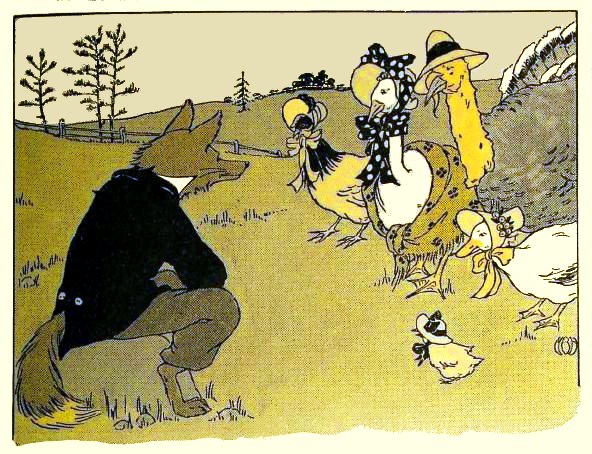
Illustration for the story "Chicken Little", 1916

Josephine Hart's novel, Damage, includes this, which I might have wrong in a word or two, but not in the concept. "Damaged people are dangerous. They have survived and they know you will too." If your life goes to hell, you'll keep breathing too. And you'll make up your own world where nothing really matters. Love doesn't matter. Promises don't matter. You'll have to keep acting right . . . tricky because everybody you make up in your pretend world has a different idea of right . . . but in the end, "right" doesn't matter either. Because even pretend worlds blow up into weightless confetti and disperse in the vacuum that remains. 

Who Hurt You So?  
by Edna St. Vincent Millay


Who hurt you so,
My dear?
Who, long ago
When you were very young,
Did, said, became, was…something that you did not know
Beauty could ever do, say, be, become?–
So that your brown eyes filled
With tears they never, not to this day, have shed…
Not because one more boy stood hurt by life,
No: because something deathless had dropped dead–
An ugly, an indecent thing to do–
So that you stood and stared, with open mouth in which the tongue
Froze slowly backward toward its root,
As if it would not speak again, too badly stung
By memories thick as wasps about a nest invaded
To know if or if not you suffered pain.
It's commonly repeated that the loss of a child is the bitterest loss. 
I think everybody's worst loss feels like The Worst Loss That Could Ever Be. 
And there are children whose souls died years ago. They breathe and walk among you.

Friday, November 22, 2013

JFK


7th grade. 
Sent back to our homerooms. 
The office turned on the public address system and we listened to the radio report. 
Then we were dismissed early and sent home on the school buses.
All those twelve-year-old kids in the halls opening and closing lockers, going down the stairs and nobody speaking a word. 
There was a barely audible shuffle of feet, and that was all.
A vacuum, a waiting.

Two years prior, my father.
Five years later, RFK and Martin Luther King, Jr.
They weren't as good as we thought they were, but we believed in them.
All dead. So much for belief.


"Down, down, down into the darkness of the grave 
Gently they go, the beautiful, the tender, the kind; 
Quietly they go, the intelligent, the witty, the brave. 
I know. But I do not approve. And I am not resigned."
~Dirge Without Music
by Edna St Vincent Millay

Monday, September 9, 2013

My inner child is weeping


My father had sent my sister and me away for the summer. My mother was in the hospital for the second or third time and (I was told, long after the event) Mrs. Furness, mother of one of my sister's friends, had started a murmuring that maybe something was going on with that man and those girls. To protect his good name, my father sent us to his brother's house. 
My cousin D was a year younger than I. Her father was a college dean. The house was big and white with many well-decorated, well-kept rooms. Everything was clean all the time, but I don't recall ever seeing anyone cleaning.
From time to time, the three of us girls would visit two kids who lived down the road . . . a sister and brother. I think the brother was younger than the sister, and possibly, younger than I. Nevertheless, he outranked me because he was on his home turf. I remember him as being volatile. One day, I think, we had a dust-up of the kind that kids have when they are all on the young side of twelve. Somebody said, "Let's pretend that..." and somebody disagreed with the vision . . . tempers rose and the group broke up into segments. 
On this day that I remember, I think my sister and D went to ride D's horse. I wasn't interested in horses, so I was walking back to D's house, feeling lonely for my own house, my own road, my own pets. From his yard, the little boy yelled to me: Why don't you go home! I hadn't known he was there, and if I had known, I wouldn't have expected him to holler at me. I was such a minor player in the group, having no standing as a real resident . . . I just went along with everything.

My heart broke. Not because it was he who'd said it, but because he asked out loud the question that rattled and rang in my head all day.
I wanted to go home, but there was no home to go to.
My mother wasn't there and my father didn't want me there.
The only place for me to be was right where I was: walking in the sun all alone on a road to a house where no one would know or worry if I was there or not.

I think it was one of the first moments in my life when I realized that there was no point in crying if no one would know, if no one would care to make it better.

Thursday, May 16, 2013

Oh, don't read this.

Joe asked what I've been up to.
Not much.

Spring came out and went back indoors again. If she comes back I won't trust her. What a thing, to be unable to trust even spring.

Peep is a good and pretty girl. She comes when called . . . a high screechy Peeep! Her own voice is so small that she is almost inaudible. She's working on learning hunting, but she isn't very good at it, except with pieces of gravel and half-dead flies. She's pretty good at catching those. She holds the gravel in her paws and stands up on her haunches and twists her body this way and that way and then throws the gravel and runs like a wild cat, her tail twisting behind her. The flies are disposed of much less histrionically.

My nephew's daughter has been born and celebrated. 
I was the fifth person to hold her on the day she was born, as if we were passing her along the branches of the family tree.
She is able to lift her head at the tender age of six weeks. Clearly, she is an exemplary child: no doubt she will cure cancer, rid the world of war, and feed all the poor. 

Husband and I are being murdered by taxes. As is my wont, I shoulder into my Duty mode, hunker down and stow away money each paycheck like a Christmas Club so that when the bills come I can haul it all out and give it away. The assessor says we've been undervalued for years, and only now are we equitably assessed. If equity is the goal, then why is our valuation the same as somebody with three times as much land, a six-bedroom house and nine outbuildings? 
Husband hunkers down too, but he vents, scaring me. 
"We won't be able to afford a pet!" 
"I'd rather live in the city and pay lower taxes!"
I shrink down inside and wait, quiet.

Robert Benchley died before I was born, and James Thurber passed away in 1961, the same year as my father. I've been rereading them both. Their humor is timeless. They make me laugh out loud.

Signed up for Netflix and we're working our way through our free first month. So many movies I haven't seen! I couldn't watch movies while the poodle boyz were still alive: they would bicker and fight and I'd have to take them out of the room. I'm queuing up movies that Husband has already seen, but he doesn't mind, bless his little heart. Saturday evening is movie night. Husband says, "Don't call it that. All the kids at work have Game Night and Movie Night and Margarita Night. I can't stand to have Nights." 

Saturday, January 26, 2013

Miscellany

When I was in my twenties or thirties a woman who had been my friend for years and years said to me, in a conversation about a mutual acquaintance, "He's like you."
"How so?" I asked.
"You know... Needy," she said.
I was offended, hurt. 
I think being insulted by being called "emotionally needy" is a result of being emotionally needy. There is the chance, too, that my friend was simply indulging in one of the opportunities that long friendship offers, that opportunity being bitchiness in the guise of neutral conversation.

One morning in the last month, the sky, with the sun peeking askance through the dense slivers of clouds, looked just like artfully layered mourning dove feathers. Taupe and pale gray and peachy-creamish and dark gray. It was beautiful. The colors were so gentle and soft, dense rather than wispy, that a photograph would have looked like nothing, would not have conveyed the peace of the light.

When my mother died, I was so relieved that I could finally cut myself free of Family. Now the nephew and niece-in-law have mucked that up with their spring delivery.  If I want a piece of Baby Girl, I'll need to be in touch with my parents' other child. It has been my experience that particular life issues recur until I've dealt with them. I think this is one of those issues. 
Dammit.

And the cold goes on and on. I took a nap this afternoon and I wouldn't have minded if I stayed asleep, or at least in bed, all covered up, until tomorrow morning. Supposed to be all the way up to 21F tomorrow.
Mmmm.
And sunny.

Tried to do laundry today. I've been saving it up all week. The drain pipe must have frozen because as the cycle reached the first "drain," it dripped down through the ceiling into the downstairs hallway and down into the cellar. I took the rest of the stuff to the laundromat where they will wash it and fold it for me and hand it back in plastic bags. Every time I have occasion to use that service, I think, "Why don't I do this all the time?????" Drop it off, pay some money, have the whole day free of laundry!


Sunday, September 30, 2012

Thank you, Moira

For months, I've been thinking frequently of a particular family who lived down the country road from my home in the 1950s. David was in my class at school, and I remember that in first or second grade he had bright red chinos with a buckle in back. David was solemn and studious. I don't have many memories of his laughing. Our school was across the road from the volunteer fire company. David's father was a member, and David knew the significance of all the siren combinations. "It's a bad one," he'd say with authority, as the siren howled eight times or ten times. "That's for mutual aid." He had three sisters, one of whom was a year or two younger and whose apple cheeks and curly dark hair I remember very clearly, and another two, who were beautiful little strawberry blonds, but really too young to be on my radar. That family was part of our neighborhood . . . an old family who, like us, had owned the land for generations back . . . and summers had us trudging up the hill down the hill around the corner by the one-room schoolhouse that Dad had gone to (and was then falling down) over to their house. Red wasn't mean, but he was a real old-time Irish patriarch. He took his parenting duty seriously. I remember his backhanding David's head if he perceived any hint of disrespect coming from that quarter. He didn't do it very often, but the thought of anybody's father whacking him a glancing (but still, pretty solid) blow on the back of the head shocked me, so the memory stuck. Sometimes, all of us kids would go over to Red's parents' old farm where he still kept cows. The old farmhouse stood in the pasture, windows gone, porch floorboards askew. "You kids stay out of there!" Red would call, and if we'd been having any thought of going inside the spooky old house, we immediately dismissed them.

Moira was the mother of the family, at once serious and cheerful. She had long dark hair that she twisted up behind her head, and ruddy cheeks and, like me, a space between her upper front teeth. I hated my space, but on her it looked good. I remember her always at the kitchen table mending things or at the kitchen sink, beginning to get supper ready. We called her Maura for a long time until one day she said, in her quiet voice, "My name is really Moira. It's an Irish name." I was fascinated. It was as if she had become a different person, exotic. I remember that she spoke to me as if I were a person and not a little kid. I remember her telling me about when she'd been baptized in the old-fashioned full-immersion style . . . and how she'd known it was coming but how surprised she'd been all the same. 

One day, the September after Dad died, I got home from school and was dismayed when, a short time later, Red's truck drove in the driveway. Mom was working and at ten I had already formed the habits of solitude and of hiding like a rabbit. Red went to the barn to do something and the dark-haired daughter hollered my name over and over and over again as loud as she could to make me come out and play with her. I hid in my bedroom and finally heard Red say, "If she doesn't want to come out, she doesn't want to come out. Leave her alone."
I was so envious that she still had her father.
We moved away a year later and I've never seen any of them again these fifty years.

So that's all, I guess. 
I've been thinking of them, and thinking of them, and today I read that Moira died two days ago. 

It's funny how the cosmos makes connections across so much space and so much time.

Saturday, July 21, 2012

Swimming

In the recent inhumanely hot temperatures, I have thought more than usual about swimming. In pools, in swimming holes in creeks, in the ocean, in lakes.


On hot days when I was little, we would pray that Dad would come home, get out of his truck and, on his way in the door, call, "Who wants to go swimming?" I think it was considered Not A Good Idea to ask or pester: we had to wait to see if Dad would feel the need for a dip. We'd hardly wait for his invitation to be out of his mouth before we'd begin to scramble out of our wilted sweaty shorts and shirts and into our bathing suits and all pile into the truck to go to the swimming hole at "the crick." I wouldn't be able to find the place now to save my soul, but it was a spot on the Kaydeross where tree roots made rough stairs in the steep bank. You could tell how many people had been there before you by the muddy slipperiness of the roots. I still love that creek mud smell, although last summer's flood somewhat tainted it for me.


I was fifteen when the family who employed me as a babysitter asked me to go with them to Bar Harbor to "nanny" for them. The kids and I stayed with the Missus' mother: there was little nannying to be done. Mr. and Mrs. went on a sailing trip with friends for a few days and then they were back to watch their own kids. They were very nice people. I think they were just being terribly kind to me and wanted to give me a vacation. If you've never swum in the ocean off the Maine coast, you haven't experienced Refreshing. I believe there is ice in the water there. That was the first time I ever experienced undertow . . . I was twirled and spun and scraped along the bottom for a few short but uncomfortably long moments. 


A summer day in my early teens: my friend's family stopped at my house to ask if I wanted to go along with them to a week's stay at a lake in Vermont. I needed to bring sheets and we had no extra sheets, so I took the dirty sheets off my bed. When my friend's mother saw those sheets . . . they were worn and torn almost from one end to the other . . . she laughed. I think that I never took them out of the car. L and I rowed a boat that was provided with the cabin and played cards at night in the yellow porch light. The lake was filled with those tall leafy weeds that twine around your legs. I tried not to make ugly sounds of fright as they stroked my legs until I swam out to deeper water where they couldn't reach me.


When I was in college, I worked as a chamber maid at a motel for one summer. One of my employee privileges was use of the motel pool after I'd cleaned all my rooms. I had the best suntan of my life that summer. First I had the worst sunburn of my life, and I continued to go out in my little red two-piece suit and cook myself through my sunburn until I was so hot I could hardly breathe. Then I'd get up, stalk to the edge of the pool and dive in without any ado. Once my flesh cooled enough for comfort, I'd climb up the stairs, go back to my lounge chair and cook some more. I was careful to remove all jewelry and spread my fingers so there would be no white areas other than those covered by my suit. If I get skin cancer, that summer is the reason.


This summer when the heat's stopped my brain from functioning well enough to accomplish anything or even to read, I've daydreamed about having a small pool here at the house. What a pleasure it would have been, last week, to spend my days and nights lolling in the water, letting it leach the heat from my blood. Then I think about having to clean the thing and make sure the chlorine's correct and having to fish out drowned rabbits and woodchucks, and a cool shower seems perfectly good.

Tuesday, June 19, 2012

Warts and scabs and other miscellaneous items

A week ago last Saturday, during one of my first Walking for Improved Health walks, I tripped over a rock in the driveway, took a couple of those graceful giant steps that one does when one's balance is . . . but hope of its return is not . . . lost. I landed on the palms of my hands and my right forearm's underside, causing small areas of impressive road rash in those areas. Gravel-on-skin hurts: Tell all the motorcyclists you know. You know how it is when you fall. You lie still for a moment to take inventory to see what hurts and at what level. Skin? Yes. Muscle? No, not much. Bone? No. All right then. Roll to the grass (white shirt now very dirty), hands and knees, and up (rear first in bovine or toddler style) to the usual upright position. Continue on, feeling embarrassed and yet, somehow, heroic. My hands are almost back to normal now and the scabs are crusty and itch enough to make me aware of them and to invite scratching and picking. 
How ladylike. 

When I was twelve-ish, there was an old woman who rented an apartment from my grandmother. No love lost between the two of them! They did not speak, did not make eye contact. But Miss Brehm, a maiden lady, sat on her porch every afternoon in the summer, watching everything that went on, and I often sat with her for a little while.  She smelled good to me in that old lady way . . . Ivory soap and denture cleaner and Spic and Span detergent and whatever else it is that made old ladies smell the way they used to. She had a dog, a husky named Silver, whom she'd trained, she said, to look both ways before he crossed the narrow paved road to do the necessary. He always did look both ways, whether or not it was taught or just good dog reasoning. I humored her, smiled. "He's smart!" I'd say. When he died I gave her a sympathy card.


A year or two earlier I had grown a wart on my knee, just below my kneecap. Miss Brehm told me to break off milkweed leaves and dab the milk on the wart. "Keep doing that every day," she said, "And that wart will disappear."
I thought she was probably crazy but I hated that wart, and there were certainly enough milkweed plants from which to take leaves, so I tried it. And by the end of the summer the wart had shrunk and shrunk and disappeared.

This morning I was up at 5:00. By 6:00 I was out the door for a leisurely period of movement. I'm not sure what I do even qualifies as "a walk." I just go outside and move my legs back and forth until, eventually, I find myself back at the door. As I came down the driveway toward the house, I noticed the milkweed plants, all new and fresh and plump, and remembered Miss Brehm. I thought of my itchy hands. I broke off a leaf of milkweed and dabbed the milk on the scabs on my right hand, leaving the left as the control hand. Who knows? 

Can't hurt, can it, after all?
And not for nothin', but my right hand doesn't itch right now and the left does.
Just sayin'.

Sunday, April 15, 2012

The Slough of Despond

I am here, languishing on the shore of the Slough of Despond, thinking thoughts too long, tired and dreary for sharing, particularly in a blog named Aging Gratefully

The slough of despond from this site

It doesn't do to think too far into the future, and it doesn't do to think too far back into the past. I need to learn (is such a change of habit possible at this age?) to dash back and grab whatever piece of information I need from those days and not spend time picking over the mess in that old junk yard.


The internal dialog:
He/she/it done me wrong!
(In the voice of the AA Sponsor): What is your part in it?
I had no part in it! It wasn't my fault!
(In the voice of the AA Sponsor): What is your part in it? Acknowledge that, first.
I was a little kid. I had no control over anything. I was supposed to be taught how to act and nobody taught me. 
Even the doctor says from the wing chair across the room, "You had no choice. You were set up."
So where does that leave a person?
I have a cavity in my heart, in my soul, that should have been filled when I was six years old.
Now it is too late to fill it, to heal it. It is too late for me to become whole.
What might I have been?
What might I have achieved?


It doesn't matter. It's all done and over and the task is to make what peace I can with it and stay in this moment, which is better . . . so much better . . . than it used to be. And so much better than it might have been.
We're all walking wounded.
This too shall pass.
I am A Fortunate Woman. I know that even when I don't feel it.

Saturday, February 18, 2012

July 11, 1959

A sunny afternoon in early summer. A crow flies over and looks down like God on an old wooden farmhouse, the green lawn in front, outbuildings surrounding the dusty barnyard in back.
On the front porch of the house, three people gather and sit on the edge of the porch, feet on the grass. A father, a mother, a daughter. The father speaks, gesturing toward some part of the landscape that he's just finished mowing. The mother pushes her hair back from her face with an arm smudged with her flower garden's dirt, and smiles an answer. The adolescent daughter wraps her legs into lissome loops, turns a curry comb in her hands, asks a question, laughs.
They are a unit, symmetrical and complete.
Fire, water, earth, green-scented air.


Inside the house, another child, a younger girl, a little girl, lies on a couch staring at a television screen. She hears the people speaking, laughing. She listens for the sound of her name, some tone of "Where is...?" but hears none. She rises and walks to the screen door and stands watching the family for a moment. They smile into each others' eyes, laugh, converse. No one notices the little girl. No one looks toward the screen where she stands. 
They are complete as they are, the three of them.
They lack nothing, no one.
The little girl turns away. Tears fill her eyes, but they do not fall.

Sunday, February 5, 2012

Lake Placid 1972

In February 1972 (forty years ago!) my friend B and I went, in my little blue Chevy Nova, to Lake Placid to watch a weekend's worth of the international winter games. 
B was short and blonde and curvy. I was tall and thin with long hair in two braids and cheekbones that could cut glass. 
The night of the opening ceremonies, all the participants made a parade, and as B and I stood watching, cheering, laughing with the rest of the commoners, two of the passing athletes waved to us, swooped their arms to invite us into the parade. B and I looked at each other with eyes and mouths wide. 
A man next to us said, "Aw, go on!" 
We ran, laughing, to catch up to the young men and we all trooped along through the village back to the lodge and a reception. "Our" two young men  . . . tall light-brown-haired Esa from Finland, dark and muscular Wolfgang from the Austrian team, were downhill skiers . . . they would compete the next morning. 
Wolfgang was quite charming.
"Do you know what my last name means in English?"
I shook my head.
"It means kiss hunter!" 
Oh my.
We felt like Cinderellas at the ball.

Image from wikipedia
Next morning we went out to Whiteface Mountain, climbed up to a good vantage point and stood watching as skier after skier zoomed by. We stayed until our feet were numb and then went back down the mountain.
We never did quite know if we'd seen Esa or Wolfgang in action, but it didn't matter. 
We talk about it now and can't believe that that was us!

Sunday, April 17, 2011

A sweet and happy Passover to you.

Pesach begins on Monday.
Al and Debbie were our Jewish Connection. 
I'm thinking today of Al and Debbie's Pesach seder. Husband and I were honored to be guests, and how I enjoyed it. 
I liked the tradition-saturated evening... 
Debbie putting her shawl over her head to light the candles with a prayer.
Marc, the youngest son (the only son, and in his thirties) answering the questions and singing the songs, one after another after another at his father's request, his voice cracking as it tired. But he sang on, such ancient melodies. The only words I recognized: Elohim; Adonai.
I liked the telling of the story, the explanation of the items on the Pesach plate. 
I liked the door left open for Elijah's arrival. It was a chilly and damp evening and every now and then Debbie would close the door for a few minutes to keep the room comfortable. "Well," Al sighed philosophically, "If Elijah comes, he'll have to wait on the deck." He chortled and the rest of us, except Debbie, smiled. I think Debbie worried that Elijah might be waiting, disappointed and frowning, when she reopened the door.
I knew much of the story . . . the blood of the lamb on the doors, the story of Miriam finding the baby floating in the basket. Marc was surprised and pleased. "Oh! You know about that?" But, clearly, there was a difference between my knowing the story and our hosts' feeling of  ownership. The story of Exodus is a Jewish story, after all. 

"In every generation, each person must feel as if he personally had come out of Mitzrayim (Egypt), as the Torah says: "You should tell your child on that day, 'When I left Mitzrayim, Hashem did miracles for me .....' "

.............[The Pesach Haggadah]

I liked the sense of continuity over thousands of years.
I even liked the derma. When Debbie brought it to the table, Marc made a face. I asked, "Why? What's in it?" It looked like bologna to me. 
"You don't want to know," Marc said, turning his face away. Everybody else tasted the slice they were given. I ate it with gusto.
It was a merry occasion, and grew merrier. Wow! That wine!
Al, at the end of the meal, standing, putting down his napkin and saying, "Next year in Israel." 
Marc explaining that even "Next year, in Israel" is traditional.


That was more than twenty years ago; I was still waiting tables. Shortly after the seder Marilyn came in. A regular customer, she always came during the afternoon lull when we had time to chat. I told her about what a great experience the evening had been. Marilyn asked, "Wait a minute! Al and Debbie who?" I told her and she threw herself against the back of the booth, jaw dropped. She had grown up across the street from the family, she and Marc had been best friends. During childhood seders they had run back and forth across the street to each other's homes, being The Guest at the seder.
I met Marilyn's parents at Al and Debbie's thirty-fifth anniversary party. I have a photo of Husband and me standing with them and we all look like blood relations. 
We went to Al and Debbie's grandson's bar mitzvah, Debbie pacing the hotel room before the ceremony, saying "Oy! Oy! I can't stop saying 'Oy'!" She was so nervous before, and so proud afterward!
And the party that evening! What a party! Everyone glittered and sparkled with joy and sequins. No holds barred for the ladies' dresses. A celebration is to celebrate! Beautiful!
The next morning, brunch in the hotel dining room. Lox! Everybody eating lox! For once I was not alone in that enjoyment.


The last time I saw Marilyn was at Debbie's funeral.
Still with the explanations: We eat eggs at this time as a symbol of life, to celebrate life.


I grew up in a family only two generations removed from old time Methodists, who disapproved of nearly every form of entertainment. So! Nu? How come whenever I take the Belief-O-Matic quiz, my result is "100% Reform Judaism"?


I miss Al and Debbie. Al's living in Florida now. 
Sometimes I miss living where we used to live. There were more Jews there.   
Small Pond is home to a few Jews, but they don't all have the Brooklyn-transplant accent. Maybe it's the accent I miss. 

Saturday, January 15, 2011

I have been thinking recently and at odd moments of this building.  
When I was in my mid-twenties, I worked for an insurance company, fixing discrepancies between what the agents paid and what they should have paid. This building was owned by, and housed, an agency with whose monthly statements I spent a lot of time. One day my boss and I took a trip down Route 9 to meet with the agent.


 Payne Horse Barn designed by Julian Burroughs
And it's for sale: "WHETHER LOOKING TO CREATE YOUR DREAM ESTATE OR UNIQUE COMMERCIAL FACILITY THE HISTORIC PAYNE BARNS ARE A MUST SEE..."

All I really remembered of its history was that Eleanor Roosevelt had had something to do with it as a school for boys.  Ms. McCord, the Esopus Town Clerk, kindly and speedily responded to my inquiry with fascinating historical information.
She wrote:
"The building which you refer to was part of the Colonel Oliver Hazard Payne Estate and was used to house the horses and chickens for the Colonel’s estate.  The estate overlooks the Hudson River and consisted of 400 acres.  I did research your reference to [the insurance agency you mentioned] and they did own the building on the south side of Rt. 9W in the 70’s and lost to foreclosure in 1976.  This building is now for sale.
The main building on the estate overlooking the Hudson housed a school in 1937 under the Mission as a shelter for neglected Black Protestant boys, eight to twelve years of age, for whom there were no programs other than the State Training Schools.  Twenty such boys [were] sent here to an experimental camp and the response was great so it was decided to operate an all-year school at West Park for such children.  The name chosen for the school was Wiltwyck, the old Dutch name of Kingston. 
Early in the history of the school the Agency helped to secure local legislation to end discrimination against Black children and then opened its doors to children without regard to race, color, or religion.  Floyd Patterson, the World Heavyweight Boxing Champion in 1960-1962, had been at this school; so the building in the city used by the school as a half-way house for boys returning to New York from West Park has been named for him.
 In May, 1942, the Wiltwyck School for Boys was incorporated with the approval of the State Dept. of Social Welfare.  As reorganized, it was administered by an interracial and nonsectarian Board of Directors.  In 1953 the school began to care exclusively for emotionally disturbed children and the program was now reorganized to provide individual case work and direct therapy where needed.  But the location of Wilwyck, eighty miles from New York City, added to the difficulty of recruiting and holding properly qualified staff so a search was begun for a new location.  In 1962 the school site transferred to Yorktown Heights.  The new campus was named for Mrs. Eleanor Roosevelt, who took an active part in the leadership of the School after its reorganization in 1942 and served as Campaign Chairman of a Building and Development fund for the new campus. 
This information is available in a book called the Town of Esopus Story and can be obtained from the Klyne Esopus Museum, P O Box 751, Port Ewen, New York 12466."


This, below, is the ceiling of the part of the building with the clock tower.  
It's the original riding arena, and it was where the Wiltwyck boys played games that needed lots of room.  
Our host and tour guide told us that the basketball hoops had still been in place when he'd bought the building.Photo of 1398 Route 9w

The realtor's blurb: "...create a dream estate..."  That insurance agent had a Dream. His insurance office was in the building (as was his and his wife's apartment, where the oval window is) and he had a vision of filling the whole place with shops and studios. It would be a huge quaintly styled shopping mall.  In the mid-1970s, giant buildings filled with stores were a novel concept. His thinking was ahead of his time, and the dream didn't turn into reality. By the time we visited the place, the bankruptcy process had already begun: my inches-thick file was useless.  The company would get a piece of whatever there was to be had, whether or not it balanced the account.

It is as close as I have come to being in one of the castles that so enchant me. It was only built in the last quarter of the 19th century, but to me it felt much older, its stone walls so thick, the windows so deep-set, the proportions so huge. It even had a kind of portcullis. While we walked through the building, our agent/host pointing out where he had planned to have this and that merchant or artist, I wanted to let the others go on ahead.  I wanted to hang behind and wander around and smell the stone and the dust and dream of what it would have been like long before.

As we were preparing to leave, my boss said to the agent, "Well, Phil . . . at least you had The Dream for a while.  And that's something a lot of people never have."

The building surely was one to inspire Dreams.  It must be, still, although I have seen it only once since 1976. Twenty-some years later, Husband and I were in Esopus as wedding guests and I made him drive back and forth on Route 9 until I spied, down the hill from the road, a corner of the roof. The driveway was chained closed. I was on fire to get out of the car and unhook the chain so Husband could see the place (...so I could see it again), but I didn't do it.
The building still grabs my imagination. I can still feel it. If I won the lottery I might take up residence there. And I would keep the chain across the driveway.

Monday, January 3, 2011

Newark, New Jersey

For those who don't know, and there are probably fewer of those than I suspect, Newark isn't pronounced New'-ark. It's Noork. They tell me.
I don't know if people who live there are called Noorkers, or Noorkians. Noorkites? I checked Newark newspapers and they all seem to use "Newark native" in place of other labels. 


I was in Newark once, but never outside the airport there. I was flying Peopleexpress Airline to Tampa and needed to deplane and find my connecting flight. I was afraid to leave the gate for long once I found it, although I do recall finding the bar, buying and disposing of two martinis, and buying a pack of cigarettes. Whether it was the general pace of New Jersey, or the atmosphere of the airport, or my own nerves, I felt sped up. I asked the cigarette seller twice in the space of ten quick seconds for a pack of matches. I think New Jersey minutes might be shorter than New York minutes.
I have a cousin who lived in Newark. At a family reunion I asked him if he liked the city. Husband would say I badgered him. After my cousin had said it wouldn't be his first choice, but it was all right, Husband said, "There. You got him to admit he hates the place where he lives. Happy now?" My cousin was pretty laidback; he wasn't offended.
Peopleexpress was a good idea at the time. No frills, no extra expense. No food, no courtesy beverages. If you expected to eat during the flight, you brown-bagged it. I believe they did allow me two ounces of nuts in a foil bag, to tide me over. The airport martinis and the nuts worked for me for a while, but I was famished when I got off the plane. 
I haven't flown anywhere in years; I gather that although Peopleexpress is no more, they set the standard for modern air traveler discomfort levels.
And I haven't been back to Newark either.

Friday, December 24, 2010

Night lights

I haven't seen any blog posts about the hoop-de-do eclipse the other night. I was up around 2:30 and the world was bright with moonlight, although clouds covered the sky. I've spoken with a couple of people who saw the world go dark around 4:00. By then I was back in my bed. I had wanted to see that eclipse sky just because the last time it happened the Tudors were in power and I'll never get another chance. Such a historic event and I missed it for want of sleep.


Earlier that day, around 5:30, I noticed a patch of pale light on the bathroom wall.  It took me a second to realize that it was a reflection of moonlight from the mirror on the opposite wall.  It charmed me because that window is small and high up on the wall, and facing nearly north/northeast as it does, it hardly ever gets direct light. There's something about patches of pale light on walls that soothes me.
When I was very young, sometimes I would stay for the random overnight at my grandmother's. Her house was one of gazillions built in a little northeast mill town in the railroad heyday of the late 19th century, the front door opening into the side hall with the stairway (that bottle of pink Air-Wick between the balusters on one of the stairs) and with the rabbit warren of upstairs rooms. No hallways in the days when that house was built, each bedroom led to another. My room, the one designated for overnight grandchildren, was a small room off her bedroom, with a small metal frame bed and a white matelasse coverlet. She would tuck me in at night, we'd say our prayers, and then she would leave me. The excitement of streetlights would keep me awake. After she'd gone back downstairs, I always looked around for a long time, just to see how different the furniture looked, illuminated by the pale secret oblongs of light cast through the windows. Streetlights! Such sophistication to a country kid.
When I grew up and lived in a tiny studio apartment, sometimes I would sit with my lamps off at night, just to look at the room in the wash of yellow-gray light that came through the windows from the street. I could move around and do almost everything I wanted to do in that light, feeling hidden yet protected, private but not alone.  The headlights from the infrequent car crossed the wall and disappeared. Here . . . and gone . . . the travelers oblivious of my observation. 
I got married and we lived in the suburbs where, shortly after our purchase of the house, the town planners in their infinitesimal wisdom changed the zoning across the street and welcomed a twenty-four hour supermarket, with adequate lighting for the parking area. I was assaulted by, pummeled by, Light all the hours of the night. I could not find a dark spot. The charm of light at night was no more. And so we moved to the country.


In the country, there is night light even when the moon is new, even on cloudy nights: I don't know where it comes from. There is no problem navigating while walking outdoors at 2am: brush and stone walls are solid humps of black and the open ways are colorless. One walks carefully, still, since the dips and bumps of the hayfields elude exposure and an ankle can turn quickly; it would be a long cold crawl back to the house. Down the hill toward the village I see the amber glow of the lights around the sheriff's office and the jail. In the other direction, through the bare trees, more orange light, a faint glow from what is called a city, twenty miles away. Amazing that that light could intrude here, across such a distance.


As I grow older, I need (they tell me, correctly) more light by which to read. To live, it seems, I want and and am comfortable with less light. A few years ago a friend who was staying with us came upon me in the pre-dawn while I was setting up the coffeemaker. 
"Why don't you turn on a light so you can see?" she asked. 
"Oh, I'm fine," I said.
"Oh," she said. "You're one of those."


It's a contradiction, since I love daylight. 
Maybe it's just artificial light that I dislike.